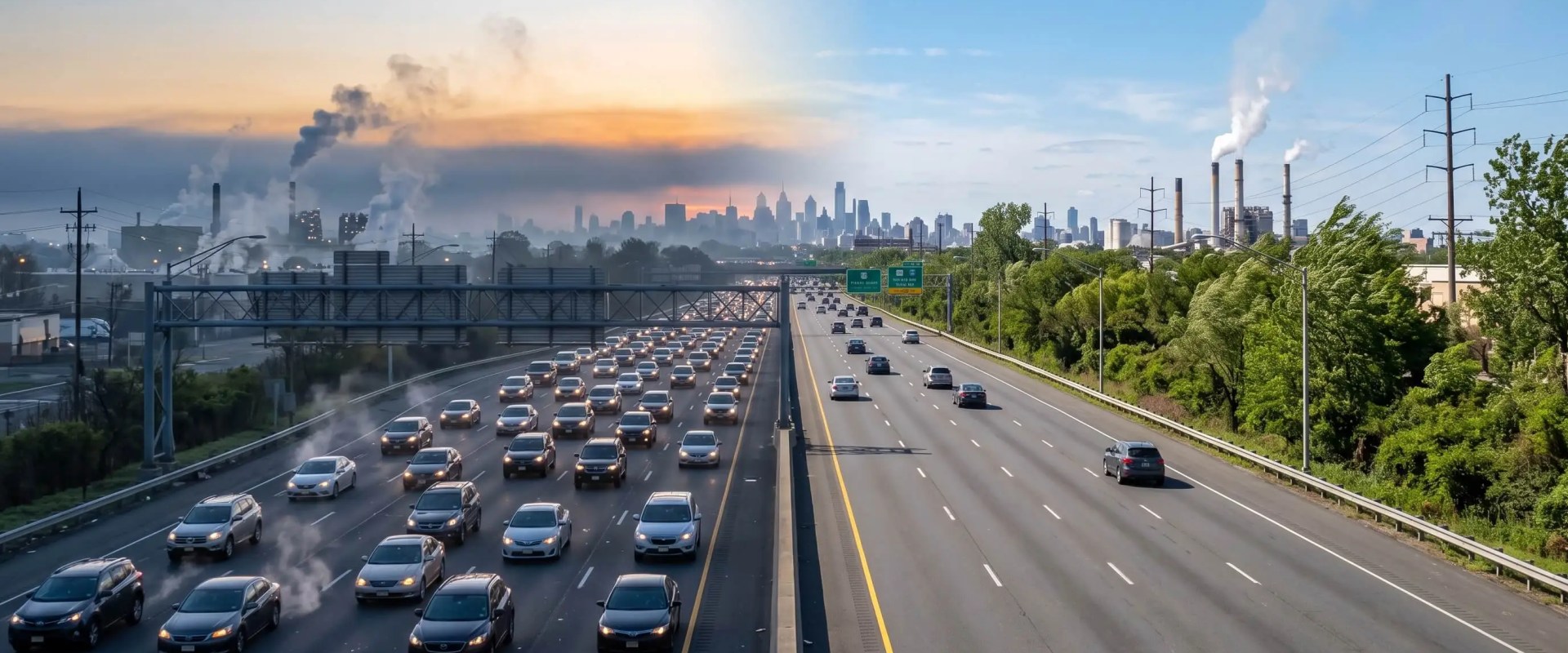
Your phone can show green at breakfast and orange by 4 p.m. on a day when the sky over New Jersey never changes. I've watched it happen from my own front step, and the first time, I assumed the app was broken.
It wasn't. Air quality in New Jersey rises and falls on a daily rhythm, and once you can see that rhythm, you can plan around it.
The air quality index on your phone gets recalculated every hour from fresh monitor readings. Here in New Jersey, those readings follow morning traffic, afternoon sun, Atlantic sea breezes and the cold evening air that holds smoke near the ground.
TL;DR Quick Answers
air quality New Jersey
New Jersey’s air quality index has never topped 200 and rarely climbs past 150, but the reading shifts hour by hour. Ozone builds on hot, sunny afternoons downwind of New York City and Philadelphia. Fine particles from wood smoke climb on cold, still evenings. Check your zone’s live reading before heading out.
Afternoon ozone: Summer readings usually peak in mid to late afternoon. That’s why Code Orange ozone days commonly run from 11 a.m. to 11 p.m.
Evening particles: In fall and winter, cold air settles under a warm layer after dark and traps wood smoke near the ground.
Shore and suburbs: Sea breezes and ozone drifting in from the big cities can push coastal and suburban counties above urban readings.
Recent grades: In the American Lung Association’s 2025 report, 12 of 14 graded counties posted worse ozone results, and five earned an F.
Indoor protection: Close windows on high-reading evenings and run a MERV 13 filter, or the highest rating your system can handle.
Top Takeaways
The live number is an estimate. Apps show a NowCast weighted toward the latest hours, so it shifts all day.
Afternoon belongs to ozone. Morning traffic supplies the ingredients and the sun does the rest.
Particles can climb after dark. Cold, still air traps wood smoke near the ground in fall and winter.
Where you stand changes the reading. Sea breezes and city plumes can push shore and suburban numbers above urban ones.
Indoor air depends on your filter. A high-efficiency filter catches particles, and a UV light won't.
What the Number on Your Screen Actually Measures
Here's something that might surprise you: the live number on most apps isn't the official daily AQI at all. The official ozone figure comes from the day's highest 8-hour average. Fine particles, or PM2.5, use a full 24-hour average.
Nobody wants to wait until midnight to decide whether the kids should play outside, so AirNow and state agencies publish a NowCast instead. It's an hourly estimate that leans hardest on the most recent readings, which is why it catches up within a few hours when pollution builds or clears. Understanding what AQI meaning really tells us can help families make better decisions as air quality changes throughout the day. Two apps can disagree at the same moment, too. They may simply pull from different monitors or sensors.
A Typical Day in New Jersey's Air, Hour by Hour
Early Morning: Rush Hour Sets the Stage
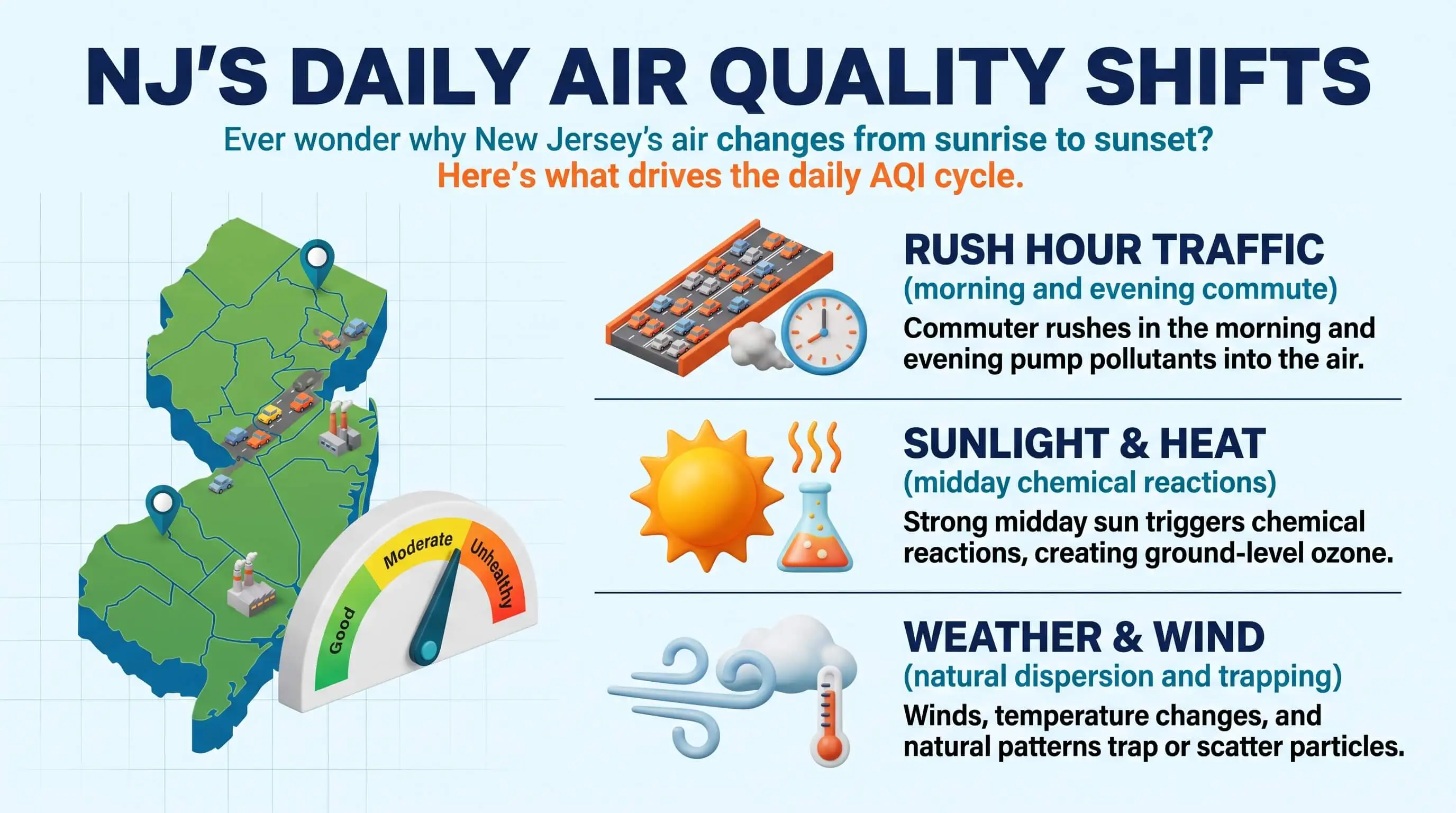
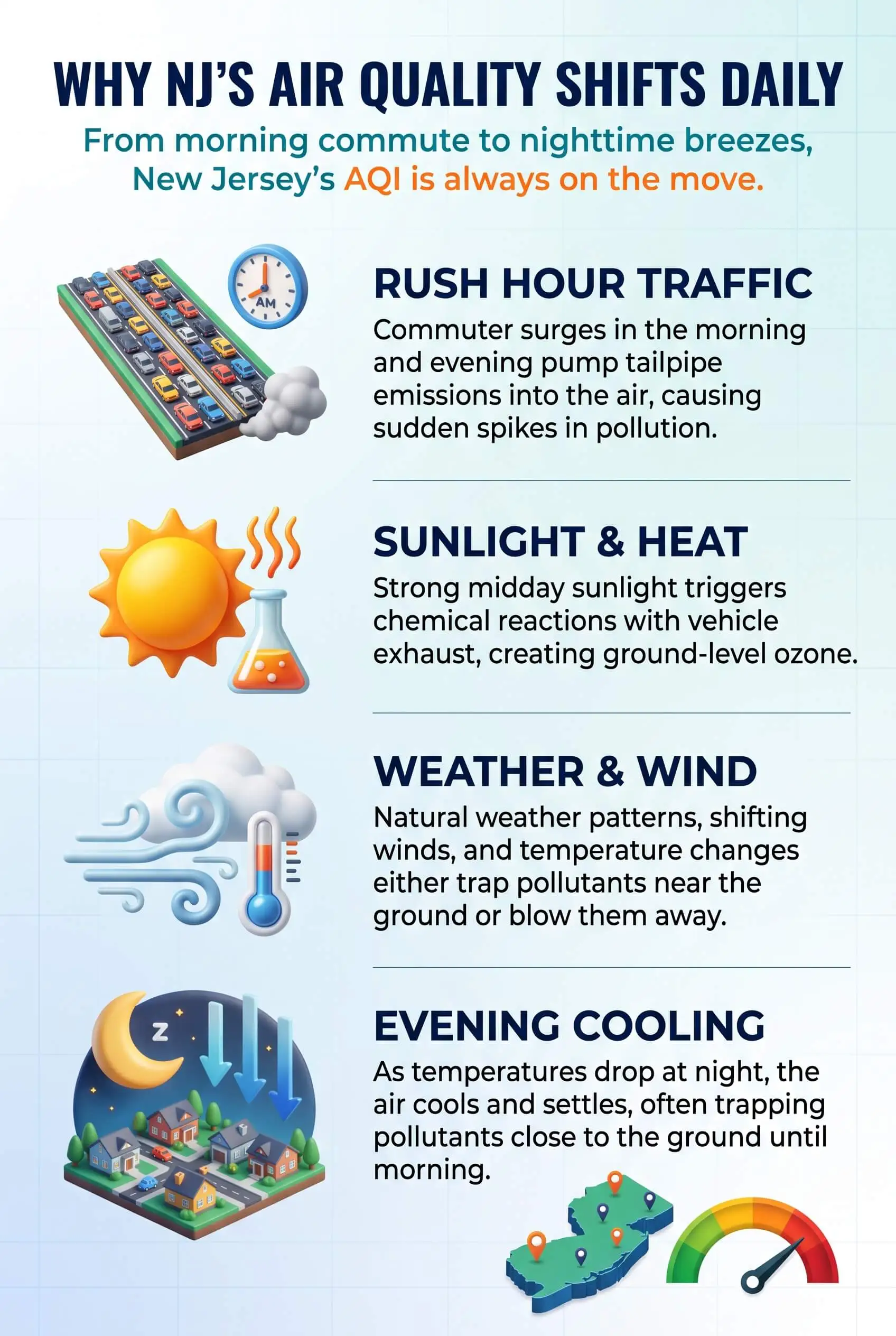
By 7 a.m., commuters on the Turnpike and I-95 and the trucks working the ports have already filled the air with nitrogen oxides and other gases. Ground-level ozone doesn't come out of a tailpipe. Sunlight has to cook those gases first, and at that hour the reaction has barely started.
Late Morning to Early Evening: Sunlight Builds Ozone
Give it a hot, sunny day with light wind and ozone climbs steadily through the late morning, usually peaking in the afternoon. New Jersey's Code Orange ozone days commonly run from 11 a.m. to 11 p.m. to cover that stretch. On those days, the state asks young children, older adults and people with asthma or other lung conditions to skip strenuous activity in the afternoon and early evening.
Evening and Overnight: Cold Air Holds Smoke Close
Ozone fades once the sun goes down. Fine particles don't always follow.
On clear, still nights the ground gives up its heat fast, and a layer of warmer air settles over the top like a lid. A Maryland Department of the Environment meteorologist explains how that inversion traps wood smoke near the ground, and every fireplace and wood stove burning on the block, backyard fire pits included, adds to what's trapped. That's how a cold October evening can read worse than a summer one.
Why the Shore, the Suburbs and the Cities Don't Match
Ozone doesn't always land where it forms. New Jersey sits downwind of New York City and Philadelphia, and plenty of the ozone those cities produce ends up over the suburbs instead.
The Atlantic adds a twist of its own. On warm days, a sea breeze pushes cool ocean air inland, and researchers studying a New York City heat wave tracked a sea breeze front forming over New Jersey by mid-morning, with ozone piling up behind it into the early afternoon. Coastal Monmouth and Ocean counties can sit under a Code Orange alert while inland towns stay yellow partly for that reason.
NJDEP and the National Weather Service forecast the state in separate zones, from Sussex and Warren down to Cape May. Check the zone you're actually in.
Weather Shifts That Flip the Reading Fast
Wind direction: A southwest wind pushes pollution up the I-95 corridor, while a turn to onshore or northwest flow can clear it out within hours.
Clouds and storms: Ozone needs sunlight, so a cloudy afternoon or a passing thunderstorm can cut a climbing reading short.
Cold fronts: Cleaner, drier air usually rides in behind one.
Passing smoke: Wildfire smoke drifts in and out on the wind, so particle readings can spike and drop within a single day.
Fall Flips the Pattern
Right now, in mid-October, the NJDEP forecast relayed by the National Weather Service names fine particles as the main pollutant in every New Jersey zone. Ozone doesn't make the list. You're watching the seasonal switch happen in real time. Summer trouble shows up on sunny afternoons, while the colder months move the bigger swings to evenings and early mornings, when inversions and wood smoke stack up.
What Hourly Swings Mean Inside Your Home
Don't take your indoor air for granted when the outdoor number climbs! The fine particles behind an orange reading don't stay outside. They slip in through gaps around doors and windows and through fresh-air intakes, so a few habits go a long way:
Air out the house when your season's readings run lowest, which usually means mornings in summer and midday in fall and winter.
Shut the windows in the evening once neighbors start burning wood.
Run a MERV 8 pleated furnace air filters, or the highest rating your system can handle, and replace it once it turns gray.
Switch the thermostat fan to "On" during smoky stretches so air keeps passing through the filter.
Pro Tip: Know what the UV light in your HVAC system is there to do. UV-C lamps target microbes on the coil. They won't trap particles or pull ozone out of the air, and some lamps produce it. NADCA notes that ozone forms at the 185-nanometer wavelength and points homeowners toward 254-nanometer lamps instead, so check your lamp's spec sheet before next ozone season.
"In my years forecasting New Jersey air, I've watched a single Monmouth County monitor read green at breakfast and orange by mid-afternoon on a July day. On a still January night, I've seen wood smoke push that same monitor into the yellow after dark as an inversion set in. The daily forecast tells you what to expect. The hourly reading closest to home tells you when to act."
7 Essential Resources
Live New Jersey Air Quality Map: Current AQI by region, the cleanest and most polluted areas right now, and indoor tips for high-AQI days.
NJDEP: What's Your Air Quality Today?: New Jersey's own AQI explainer, with EnviroFlash alert sign-up and ozone exceedance reports.
AirNow: AQI Basics: What each color category means for your health.
AirNow API: Air Quality 101: How daily averaging works and where real-time NowCast values come from.
AirNow-Tech: AQI Calculations Overview: The technical rules behind daily and hourly ozone and PM2.5 numbers.
EPA: Ground-Level Ozone Basics: How traffic and industrial gases react in sunlight to form ozone.
National Weather Service Mount Holly: Air Quality Forecast: NJDEP's zone-by-zone forecast, including the main pollutant for each New Jersey region.
3 Supporting Statistics
The American Lung Association's 2025 report found that 12 of New Jersey's 14 graded counties posted worse ozone results than the year before, and five of them earned an F. American Lung Association: 2025 New Jersey State of the Air
Working from the same report, the Sierra Club's New Jersey chapter counted 11 of 14 graded counties with a D for particle pollution. Sierra Club New Jersey Chapter Analysis
In a NOAA-archived study around New York City, ozone behind the sea breeze front hit 143 parts per billion at 1 p.m. EST, roughly four hours after the first morning peak showed up. NOAA Repository: Sea Breeze Life Cycle and Ozone Patterns Around NYC
Final Thoughts and Opinion
In my view, one morning glance at the AQI tells you only part of the story in New Jersey. Ozone does its damage in the afternoon. In the colder months, particles do theirs after dark.
The habit that actually protects your family is checking the reading for the hour you plan to be outside, then closing up on smoky evenings and running a filter that catches fine particles. If your air conditioning system isn't filtering properly, call a certified expert for a repair to help keep indoor air clean. Better timing, more than any new routine, is what makes you the hero of your household's air.
Frequently Asked Questions
Why Is My AQI App Different From the NJDEP Reading?
Your app may use a different monitor or mix in corrected low-cost sensors, and it may refresh on its own schedule. When the numbers disagree, go with the state reading for your forecast zone.
Why Does Air Quality Get Worse at Night in Winter?
Clear, calm nights set up an inversion, with a layer of warm air sitting on top of colder air near the ground. Wood smoke and other particles stay trapped underneath until the morning sun stirs things up again.
Does Rain Clean the Air in New Jersey?
Usually. Clouds and rain cut off the sunlight ozone needs, and showers wash some particles out of the air.
Is the Jersey Shore Air Cleaner Than North Jersey?
Not always. A sea breeze on a warm day can carry ozone right into coastal counties, which is why Monmouth and Ocean show up on summer ozone alerts.
When Should I Open My Windows?
Mornings usually win in summer. In fall and winter, midday tends to beat the evening, when wood smoke and inversions push particle levels up. Using one of the best air purifiers at home can also help reduce indoor particle levels when outdoor air quality worsens.
Check the Hour You Step Outside
The reading that matters most is the one for the hour you head out, in the zone where your family actually lives. Make that quick check part of your plans, and you'll know when New Jersey's air is at its best. Pairing this habit with top air filters can also help protect your indoor air when outdoor pollution levels rise.


